The Corporate Sustainability Reporting Directive expands the existing sustainability reporting requirements and brings more companies under its scope.

By Paul A. DaviesMichael D. Green, and James Bee

On 21 June 2022, the European Parliament and European Council reached a provisional political agreement on the terms of the EU’s proposed Corporate Sustainability Reporting Directive (CSRD). The CSRD will extend the current sustainability reporting requirements in the EU (namely those under the Non-Financial Reporting Directive (NFRD)), to include more companies and topics and to require more detailed disclosures, and represents a key piece of legislation in the international trend towards increasing sustainability-related reporting by companies. The European Parliament indicated this international aim in its press release announcing the agreement, stating that the CSRD “aims to end greenwashing and lay the groundwork for sustainability reporting standards at global level.”

While the full text of the agreed version of the CSRD has not yet been made public, the press releases from the European Parliament and Council do shine some light on the key provisions that will likely be included in the final document.

Public agencies prevailed in 71% of CEQA cases analyzed.

By James L. Arnone, Daniel P. Brunton, Nikki Buffa, Marc T. Campopiano, Peter J. Gutierrez, John C. Heintz, Lauren E. Paull, Aron Potash, Lucas I. Quass, Natalie C. Rogers, Jennifer K. Roy, and Winston P. Stromberg

Latham & Watkins is pleased to present its fifth annual CEQA Case Report. Throughout 2021 Latham lawyers reviewed each of the 51 California Environmental Quality Act (CEQA) appellate cases, whether published or unpublished. Below is a compilation of the information distilled from that annual review and a discussion of the patterns that emerged.

In 2021, the California Courts of Appeal issued 51 opinions that substantially considered CEQA while the US District Court for the Northern District of California issued one opinion. Notably, 2021 saw an increased focus on CEQA wildfire analysis. In cases like Sierra Watch v. County of Placer, the Court of Appeal ruled that the County of Placer failed to adequately analyze wildfire risks by wrongly assuming first responders would provide traffic control in the event of an emergency. And in Newtown Preservation Society v. County of El Dorado, the Court upheld a mitigated negative declaration in the face of public concerns that a bridge reconstruction project would result in significant impacts on resident safety and emergency evacuation in case of a wildfire.

Also notable in 2021 was the rare occurrence of a Court of Appeal partially affirming the denial of an anti-SLAPP motion following a CEQA lawsuit. In Dunning v. Johnson, the Court found that a project developer had established a probability of demonstrating lack of probable cause for the underlying CEQA petition, as well as a probability of demonstrating that the petitioners pursued the CEQA litigation with malice.

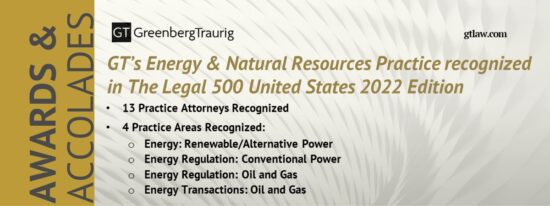
Thirteen attorneys from the Energy & Natural Resources Practice of global law firm Greenberg Traurig, LLP are recognized in The Legal 500 United States 2022 Guide. The annual Guide once again recognized the firm in Energy Regulation: Conventional Power, Energy Regulation: Oil and Gas, Energy: Renewable/Alternative Power, and Energy Transactions: Oil and Gas.

The

The Claims Code seeks to ensure the integrity of voluntary carbon markets to support achievement of the Paris Agreement goals.

By Jean-Philippe Brisson, Paul A. DaviesSarah E. ForttBetty M. Huber, Alicia Robinson, and Deric Behar

The Voluntary Carbon Markets Integrity (VCMI) Initiative is “a multi-stakeholder platform to drive credible, net-zero aligned participation in voluntary carbon markets.” The VCMI Initiative, for which the UK government announced its support in March 2021, is co-funded by the Children’s Investment Fund Foundation and the UK Department for Business, Energy, and Industrial Strategy. A central objective of VCMI is to issue guidance for companies and other non-state actors on how carbon credits can be voluntarily used and claimed as part of credible net zero decarbonization strategies. To further this objective, VCMI published for public consultation a Provisional Claims Code of Practice (Claims Code) on June 7, 2022.

It is no secret that China has long struggled with implementing measures for pollution control and regulating hazardous chemicals. We have watched this issue closely and published about it in years past here. However, on May 24, 2022, the China State Council issued its most focused plan yet, known as the “New Pollutant Control Action Plan” or “新污染物治理行动方案,” and it will likely have far-reaching impacts on companies manufacturing, using or discharging certain chemicals in China. It could also impact companies outside of China importing chemicals into China.

Forced Labor Enforcement Task Force issues required enforcement strategy, including guidance to importers.

By Erin Brown Jones, Paul A. Davies, Sarah E. Fortt, Betty M. Huber, Nathan H. Seltzer, Michael D. Green, James Bee, and Angela Walker

On June 21, 2022, the key operative provision of the Uyghur Forced Labor Prevention Act (UFLPA) entered into force, introducing a “rebuttable presumption” that any goods mined, produced, or manufactured wholly or in part in the Xinjiang region of China are in violation of Section 307 of the Tariff Act of 1930. Under the rebuttable presumption, any such goods are — unless proven otherwise by importers who comply with specific due diligence guidance and submit “clear and convincing evidence” that the goods were legitimately manufactured — presumed to be produced using forced labor, and therefore cannot be imported into the US and will be detained at the border. For more information on the UFLPA, see this Latham blog post.

Air Quality: PA DEP Releases Rulemaking Proposal for VOC Emissions
On June 14, 2022, the Pennsylvania Department of Environmental Protection held a meeting and released a Final Rulemaking regarding volatile organic compound (VOC) emissions. It affects the following VOC sources, “storage vessels; natural gas-driven continuous bleed pneumatic controllers; natural gas-driven diaphragm pumps; reciprocating and