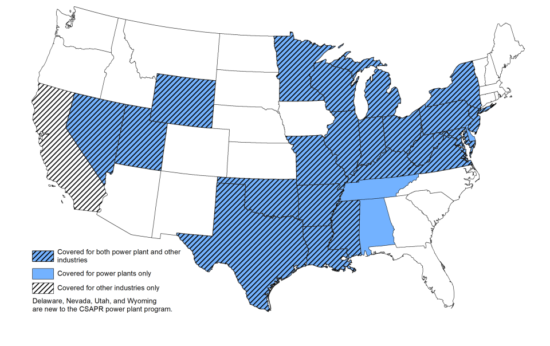
On April 6, 2022, the United States Environmental Protection Agency (EPA) published a proposed rule in the Federal Register that would build on its existing Cross-State Air Pollution Rule (CSAPR) program by limiting further the emission of nitrogen oxides (NOx) from stationary sources located in 26 states. 87 Fed. Reg. 20,036 (Apr, 6, 2022). The proposal would implement EPA’s 2015 National Ambient Air Quality Standards (NAAQS) for ozone of 70 parts per billion by imposing Federal Implementation Plans (FIPs) on specified states pursuant to its authority under the “good neighbor” requirements of section 110(a)(2)(D)(i)(I) of the Clean Air Act. This provision requires upwind states to prevent sources located within their borders from contributing significantly to nonattainment or interfering with maintenance of the NAAQS in downwind states.

On March 11, 2022, the Department of Labor (“DOL”) proposed reverting the definition of “prevailing wage” under the Davis-Bacon Act to a definition used over 40 years ago. According to the DOL, the proposal is meant to modernize the law and “reflect better the needs of workers in the construction industry and planned federal construction investments.”[1]

In a move consistent with EPA’s recent uptick in oversight of state regulatory programs, EPA has proposed to establish federal water quality standards (WQS) for human health criteria (HHC) for Washington state. The proposal comes less than two months after the Office of Water rescinded a memorandum that directed EPA regions to comply with Clean Water Act statutory deadlines and give sufficient deference to technical determinations made by states that administer EPA-approved delegated Clean Water Act programs. While the proposal itself is not surprising — EPA telegraphed that it would take this action early in this administration — the timing of the proposal is somewhat surprising.

by Kelly A. Daly

Yesterday, the Federal Energy Regulatory Commission (“FERC”) submitted its Fiscal Year 2023 Congressional Justification. This document, which is submitted annually, consolidates the Annual Performance Plan with the Performance Budget Request for the primary purpose of communicating the agency’s accomplishments in the prior fiscal year and establishing goals to pursue its mission

On April 3, representatives of the hydropower industry, Native American tribes, and conservation organizations provided a package of proposed legislative reforms to the Federal Power Act (FPA) to the ranking members of the U.S. Senate’s Energy and Natural Resources Committee and the U.S. House of Representatives’ Energy and Commerce Committee. The package, which was developed as part of the Stanford University Uncommon Dialogue on hydropower and river conservation, is the result of year-long intense negotiations between a variety of hydropower stakeholders.

On March 21, a number of international, national, regional, and local environmental and nonprofit organizations, as well as several businesses, petitioned (Petition) the Environmental Protection Agency (EPA) to institute a rulemaking to add dams and reservoirs as a source category under the Greenhouse Gas Reporting Program (GHGRP). The GHGRP requires reporting of greenhouse gas (GHG) data and other relevant information from large GHG emission sources, such as fuel and industrial gas suppliers. Approximately 8,000 facilities are required to report their emissions annually, and the reported data are made available to the public in October of each year.

In 2017, following multiple legislative proposals and lengthy negotiations, France became the first EU Member State to adopt a cross-sectoral law on Corporate Sustainability Due Diligence (the “French Law“). At the time the French Law was adopted, it was highly criticized, in part because France appeared to be going “out on a limb” and a broader international response was felt to be necessary.

This February, an important step towards an EU-wide Corporate Sustainability Due Diligence legal framework was taken with the Proposal of the EU Commission for a Directive on Corporate Sustainability Due Diligence (the “EU Proposal“). This follows legislative developments in individual EU Member States mandating human rights and environment due diligence in supply chains – see our previous blog posts on national HREDD movements in Germany and the Netherlands, for example.

The State Water Resources Control Board (“Water Board”) is now receiving public comments on certain components of its revised proposed statewide National Pollutant Discharge Elimination System (“NPDES”) Construction Stormwater General Permit (“Construction Stormwater General Permit”).

The first draft Construction Stormwater General Permit was released by the Water Board on May 28, 2021, following Staff’s preliminary draft released in November 2020 and consideration of public comments raised in public workshops held in December 2020.  A revised proposed draft Construction Stormwater General Permit was released on March 30, 2022.  Water Board Staff is now accepting comments on the following items in the revised draft Permit:

  • Anti-degradation findings set forth in Order, Findings 9-18;
  • Regulatory transition requirements set forth in Order, Section III.C;
  • Sediment-based numeric effluent limitations for 14 pollutants as set forth in total maximum daily load (“TMDL”) implementation requirements in Attachment H section I.G.5, and the Fact Sheet sections I.G.5.g and I.W.6.g; and
  • Nitrogen-based nutrient numeric action levels for the Los Angeles Area Lakes TMDL, the Los Angeles River Nutrients TMDL, the Santa Clara River Nitrogen Compounds TMDL, and the Ventura River Algae TMDL in Table H-2 of Attachment H, and in Fact Sheet sections I.G.5.d and I.W.6.d.