
Ag-Gag Statutes: Supreme Court Denies Petition to Decide Whether First Amendment Protects ‘Newsgathering Activities’ in Non-Public Farm Areas
On October 16, 2023, the U.S. Supreme Court denied a petition for a writ of certiorari for a case seeking reversal of the U.S. Court of Appeals for the Fourth Circuit’s decision upholding parts of North Carolina’s
International businesses with operations in the EU: Are you taxonomy-ready?

What is a taxonomy anyway?
The EU’s “Taxonomy” is a classification framework that determines whether an economic activity is environmentally sustainable.
Under EU legislation, “large” EU companies will soon need to report on their taxonomy “alignment” as part of their mandatory sustainability disclosures. This means, at risk of oversimplifying, reporting on the extent to which
Advantages of Adopting the Model State Indoor Air Quality Act: Prioritizing Human Health Amid Energy Concerns

Adopting indoor clean air standards far outweighs any concern surrounding energy consumption
Shale Law Weekly Review—Week of October 23, 2023
Infrastructure: DOE Announces Phase 1 Award Winners in Buildings UP Program
On October 11, 2023, the Department of Energy (DOE) Office of Energy Efficient and Renewable Energy (EERE) announced $22 million in awards through its Buildings Upgrade Prize (Buildings UP). The Building Up program awards groups developing building upgrades focusing on energy efficiency and greenhouse
SEC Adopts Changes to Names Rule for Registered Funds

The amendments aim to modernize the Names Rule and promote investor protection objectives by ensuring that a fund’s portfolio of holdings aligns with its name.
By Laura N. Ferrell, Sarah E. Fortt, Betty M. Huber, Paul A. Davies, Nicola Higgs, Anne Mainwaring, Karmpreet (Preeti) Grewal, Austin J. Pierce
How to Prepare for California’s New Workplace Violence Prevention Law

On September 30, 2023, California Governor Gavin Newsom signed SB-553 into law. SB-553 is the nation’s first workplace violence prevention law. The law adds a new section 6401.9 to the California Labor Code, which will be implemented by Cal/OSHA. The new law requires that employers an effective plan aimed at preventing workplace violence in place
Greenberg Traurig Continues to Strengthen Energy & Natural Resources Practice with Regina A. Pearson in Austin

Global law firm Greenberg Traurig, LLP continues its strategic growth in Texas and its Energy & Natural Resources Practice with the addition of Regina A. Pearson as a shareholder in the Austin office. Pearson joins Greenberg Traurig from Faegre Drinker, where she served as co-chair of the infrastructure team, co-lead of the energy asset
Greenberg Traurig’s Environmental Practice Receives 5 Recognitions in 2024 Edition of Benchmark Litigation United States
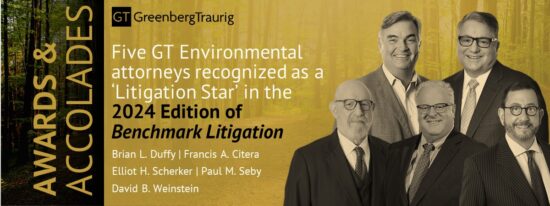
Benchmark Litigation United States recognized five Greenberg Traurig attorneys in the firm’s Environmental Practice as Litigation Stars in its 2024 edition.
Benchmark Litigation is a guide to the world’s leading litigation firms and lawyers. According to the publication’s website, it provides law firm and lawyer rankings based on extensive interviews with litigators, dispute resolution specialists, and their clients,
EPA’s Latest Proposed Coal Ash Rule May Impact Beneficial Use
EPA’s latest proposed CCR regulations could impact beneficial use practices.
SCOTUS Will Have a Full Bench to Review Chevron Deference
Chevron deference is squarely in the U.S. Supreme Court’s crosshairs. The Court has had on its October docket an appeal in Loper Bright Enterprises v. Raimondo, which challenges the long-standing doctrine. First established by the Court in the 1984 Chevron v. NRDC case, the doctrine imposes a two-part test when courts determine whether to defer