Greenberg Traurig, LLP

Greenberg Traurig, LLP (GT) has approximately 2,100 attorneys in 41 locations in the United States, Latin America, Europe, Asia, and the Middle East. GT has been recognized for its philanthropic giving, diversity, and innovation, and is consistently among the largest firms in the U.S. on the Law360 400 and among the Top 20 on the Am Law Global 100.

Latest from Greenberg Traurig, LLP - Page 27

Greenberg Traurig, LLP Shareholders Steven C. RussoDoreen U. Saia, and Zackary D. Knaub were named to City & State’s “2022 Energy & Environment Power 100” list. According to the publication, the Energy & Environment Power 100 list “highlights the key players in New York who are reshaping the energy industry – and

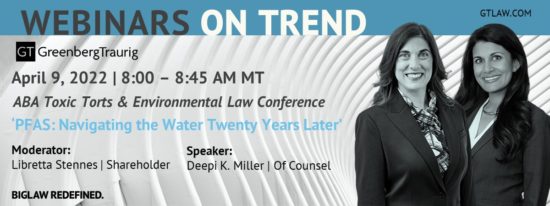
Libretta Stennes, a shareholder in global law firm Greenberg Traurig, LLP’s Minneapolis office, and Deepi K. Miller, an of counsel in the firm’s Sacramento office, will speak at the American Bar Association (ABA) 30th Annual Toxic Torts and Environmental Law Conference taking place April 7-9 in Scottsdale, Arizona.

Click here

Maribel N. Nicholson-Choice, an Environmental Practice shareholder at global law firm Greenberg Traurig, P.A., was recognized as a 2022 “Woman on the Move” by ONYX magazine.

For the sixth consecutive year, ONYX recognized Florida’s most influential black women in business, education, government, media, and non-profit organizations.

Click here to continue reading the full GT press

Registered public companies would be required to report their greenhouse gas (GHG) emissions and certain information regarding climate-related financial risks and metrics, including any actual or likely material impacts to their businesses, pursuant to a long-awaited proposed rule the U.S. Securities and Exchange Commission (SEC) voted 3-1 to issue on March 21, 2022.

Click here

Superfund lawyers often confront vexing problems in allocating responsibility among parties jointly and severally liable under the Comprehensive Environmental Response, Compensation and Liability Act (CERCLA). Litigation cost is prominent among those problems. With no statutory limitations on what “equitable factors” might matter to an allocation, see 42 U.S.C. § 9613(f)(2), literally any fact could be