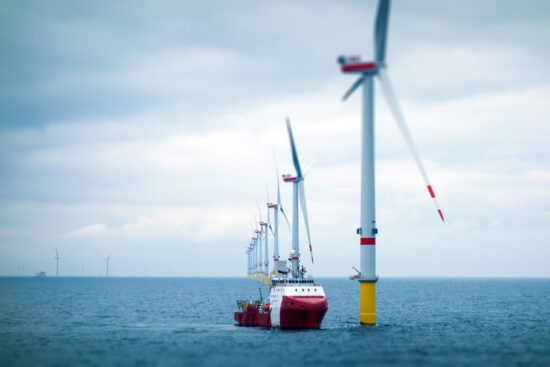
California recently enacted two laws—the Offshore Wind Expediting Act (SB 286) and the California Offshore Wind Advancement Act (AB 3)—to accelerate the development of offshore wind energy that could have significant implications for the industry and its stakeholders. The new laws aim to streamline the offshore wind permitting process, promote collaboration among state agencies


By Adam R. YoungJames L. CurtisMelissa A. OrtegaPatrick D. Joyce, and Craig B. Simonsen

Seyfarth Synopsis: OSHA Region V last week provided a Webinar on the Occupational Safety and Health Administration’s (“OSHA”) national emphasis program (“NEP”) to prevent workplace hazards in warehouses, processing facilities, distribution centers, and high-risk

The voluntary code aims to enhance transparency and improve comparability and reliability of ESG data and scores.

By Paul A. Davies, Farhana Sharmeen, Michael D. Green, James Bee, and Kevin Mak

The Monetary Authority of Singapore (MAS) has published a Code of Conduct for Providers of Environmental, Social, and Governance (ESG) Rating and Data Products (Code), and an accompanying compliance checklist for providers (Checklist), following a public consultation conducted from June to August 2023. The Code covers best practices on governance, management of conflicts of interest, and transparency of methodologies and data sources, including disclosure on how forward-looking elements are taken into account in data products. This disclosure is intended to allow users to better consider transition risks and opportunities when determining capital allocation.

For more details on the initial consultation, please see this Latham article.

In the early hours of December 14, 2023, the Council of the EU (“Council”) and the European Parliament (“Parliament”) reached a provisional political agreement on the Corporate Sustainability Due Diligence Directive (“CSDDD”). Described as a “historic breakthrough” by Lara Wolters, who has led this file for the Parliament, the CSDDD will require many companies in the EU and beyond to conduct environmental and human rights due diligence on their global operations and value chain, and oblige them to adopt a transition plan for climate change mitigation.

Given the CSDDD’s relevance for companies’ ongoing compliance planning on environmental and human rights matters, this blog aims to advise clients on the basic elements of the CSDDD agreement based on press releases from the Council, Parliament, and the European Commission (“Commission”), even if much uncertainty remains. Although a political agreement has been reached, the text of the agreement is not publicly available and a number of details of the legal text will need to be finalized in follow-up technical meetings. Covington will publish a more detailed alert on “how to prepare” for the CSDDD once the full text is available (likely in early 2024).

The new rules would oblige companies to integrate their human rights and environmental impact into their management systems.

By Paul A. Davies, Michael D. Green, and James Bee

On December 14, 2023, the European Council (Council) and European Parliament (Parliament) reached provisional agreement on the Corporate Sustainability Due Diligence Directive (CSDDD). The agreement follows an extensive negotiation processes, which began in June 2023, after the European Commission had initially proposed the CSDDD in February 2022.

The CSDDD’s key aim is to enhance the protection of the environment and human rights globally. The CSDDD as proposed will set obligations for companies regarding the actual and potential adverse impacts of their own operations, those of their subsidiaries, and those carried out by business partners, described as the “business chain of activities.” The CSDDD would also establish a requirement for large EU companies to adopt a plan to ensure that their business model and strategy are compatible with the Paris Agreement, i.e., including concrete targets and measures in line with limiting global warming to 1.5 °C.

The proposed CSDDD would establish rules on penalties and civil liability for infringements (although these will ultimately be set by Member States).

On 14 December 2023, following several rounds of inter-institutional negotiations, the European Council of the European Union (Council) and the European Parliament (Parliament) announced that a political agreement had been reached on a Directive on Corporate Sustainability Due Diligence (CS3D).  The European Commission (Commission) had initially published its proposal for CS3D on 23 February 2022, with the Council and the Parliament issuing their own positions on the text on 30 November 2022 and 1 June 2023, respectively (see our previous blogs, here, here and here).

Inspired by the 2017 French law on Corporate Duty of Vigilance and the 2021 German Supply Chain Law (see our previous blog post), and in response to growing stakeholder expectations and demands in the EU and globally, CS3D sets out EU standards for human rights and environmental due diligence (HREDD), requiring in-scope companies to mitigate their negative impact on human rights and the environment with respect to their own operations, those of their subsidiaries and those carried out by their business partners. In so doing, CS3D seeks to provide legal certainty and a level playing field as regards corporate supply chain obligations.

Most UK climate litigation concerns challenges to the decisions of public authorities on projects with environmental effects or policies being adopted by Government that can have significant impacts on the environment.

A series of five recent decisions in the courts – all of which have rejected challenges based on climate grounds – show that the UK courts are extremely reluctant to call into question the decisions of national or local public authorities in the case of individual projects.  However, as we will see, there is room for challenges to be successful in limited circumstances which we consider below.