On September 30, 2023, California Governor Gavin Newsom signed SB-553 into law. SB-553 is the nation’s first workplace violence prevention law.  The law adds a new section 6401.9 to the California Labor Code, which will be implemented by Cal/OSHA.  The new law requires that employers an effective plan aimed at preventing workplace violence in place

Global law firm Greenberg Traurig, LLP continues its strategic growth in Texas and its Energy & Natural Resources Practice with the addition of Regina A. Pearson as a shareholder in the Austin office. Pearson joins Greenberg Traurig from Faegre Drinker, where she served as co-chair of the infrastructure team, co-lead of the energy asset

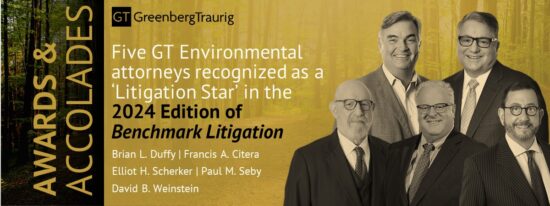
Benchmark Litigation United States recognized five Greenberg Traurig attorneys in the firm’s Environmental Practice as Litigation Stars in its 2024 edition.

Benchmark Litigation is a guide to the world’s leading litigation firms and lawyers. According to the publication’s website, it provides law firm and lawyer rankings based on extensive interviews with litigators, dispute resolution specialists, and their

Chevron deference is squarely in the U.S. Supreme Court’s crosshairs. The Court has had on its October docket an appeal in Loper Bright Enterprises v. Raimondo, which challenges the long-standing doctrine. First established by the Court in the 1984 Chevron v. NRDC case, the doctrine imposes a two-part test when courts determine whether to

Our international ESG team has been keeping an eye on what’s going on with regards to green taxonomies. With so much activity already this year, we summarize some of the key developments below.

EU

We recently published this reminder of the EU’s taxonomy framework. Our publication is particularly relevant to non-EU groups with large subsidiaries

On October 7, 2023, California Governor Newsom signed two landmark bills into law, Senate Bill (SB) 253 and SB-261, imposing new requirements on large companies doing business in California to publicly report their annual greenhouse gas (GHG) emissions and climate-related risks. These laws apply to both publicly traded and privately held companies, exceeding the scope of the climate disclosure rule proposed by the U.S. Securities and Exchange Commission (SEC) in March 2022. Our professionals have prepared a more detailed summary here; some key highlights are included below.

In an opinion filed September 13, and modified and certified for publication on October 6, 2023, the Fourth District Court of Appeal (Div. 3) affirmed the trial court’s judgment denying a CEQA writ petition challenging the City of Laguna Beach’s determination that the Guidelines’ Class 31 categorical exemption applied to its approval of a project to remodel a historic single family home.  Historic Architecture Alliance, et al v. City of Laguna Beach, et al (Ian and Cherlin Kirby, Real Parties in Interest) (2023) 96 Cal.App.5th 186.    The decision refines the established CEQA principle that a project that may cause a change in the significance of a historical resource is also one that may have a significant environmental effect (and thus require an EIR or MND) in the unique context of CEQA’s categorical exemption for projects found to be consistent with the “Secretary of the Interior’s Standards for the Treatment of Historic Properties” (the “Secretary’s Standards”).  (CEQA Guidelines, § 15331.)  It also clarifies that the “fair argument” test does not apply to a project opponent’s attempt to establish the historical resource exception (Guidelines § 15300.2(f)) to this categorical exemption; because both the exemption and the exception require the lead agency to make the same factual determination – i.e., the project’s consistency with the Secretary’s Standards – applying the fair argument test to the exception would render the exemption meaningless.