
Post-Production Costs: Title: District Court Denies Diversified’s Motion for Judgment on the Pleadings in Abandoned Wells Class Action Suit
On Thursday, June 1, 2023, the United States District Court for the Northern District of West Virginia denied Defendant Diversified Energy Co.’s (Diversified) Motion for Judgment on the Pleadings in the case of McEvoy v. Diversified
30 Environmental Practice Attorneys Recognized in The Legal 500 U.S. and LATAM 2023 Guides
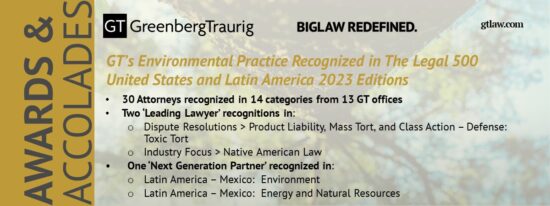
Thirty attorneys in 13 U.S. and Latin America offices from the Environmental Practice of global law firm Greenberg Traurig, LLP are recognized in The Legal 500 United States 2023 Guide and The Legal 500 Latin America 2023 Guide. David B. Weinstein was recognized in the U.S. Guide as a “Leading Lawyer” for Dispute Resolution >
Agricultural Law Weekly Review—July 3, 2023
Food Labeling: USDA Issues Grant of Inspection to Upside Foods, Furthering Commercial Cell-Cultured Chicken Sales
On June 21, 2023, Upside Foods announced that the U.S. Department of Agriculture (USDA) Food Safety and Inspection Service (FSIS) issued the company a Grant of Inspection (GOI), marking the completion of the pre-market regulatory review process required for
European Deforestation Regulation Enters Into Force
The regulation aims to minimise the EU’s contribution to deforestation and forest degradation.
By Paul A. Davies, Michael D. Green, and James Bee
The European Deforestation Regulation (EUDR) entered into force on 29 June 2023, following publication in the Official Journal of the European Union. However, the main requirements and prohibitions of the EUDR will apply from 30 December 2024, 18 months after the entry into force.
The regulation forms part of the European Green Deal (for more information on the Green Deal, refer to Latham’s blog post here), which includes a proposal to ensure EU consumption does not contribute to deforestation and forest degradation. The EUDR will repeal and broaden the scope of the existing EU Timber Regulation.[i]
Digital ESG credentials for micro, small and medium-sized enterprises globally – from Singapore to the world

Businesses, especially micro, small and medium-sized enterprises (MSMEs), continue to face practical challenges in ESG reporting due to costs, the lack of resources and expertise on sustainability reporting, and the complexities around multiple standards and reporting frameworks in use globally.
On 22 June 2023, the Monetary Authority of Singapore (MAS), United Nations Development Programme (UNDP) and the Global Legal Entity Identifier Foundation (GLEIF) announced an initiative to develop digital ESG credentials for MSMEs worldwide to facilitate ESG reporting for this sector. The initiative, named Project Savannah, will produce a multi-jurisdictional proof of concept targeted for launch at the upcoming COP28.
In God We Trust Wins 9 – 0

Title VII requires an employer that denies a religious accommodation to show that the burden of granting that accommodation would result in undue hardship in the conduct of the business
Employers Feeling the Heat: Washington Adopts Permanent Changes to Outdoor Heat Exposure Rules Effective July 17, 2023
By Hoorya R. Ahmad and Patrick D. Joyce
Seyfarth Synopsis: Effective July 17, 2023, employers with outdoor workers in the state of Washington will be required to follow revised heat illness prevention rules. The revised rules modify Washington’s long-standing 2008 rule and expand employees subject to the rule’s protection. Employers should review the required Washington
Harm to Public Interest in Informed Decisionmaking Can Tip the Scales When Courts Weigh Preliminary Injunctions

In Tulare Lake Canal Company v. Stratford Public Utility District (2023) 92 Cal.App.5th 380, the Fifth District Court of Appeal reversed and remanded a trial court order denying a preliminary injunction to halt the construction of a water pipeline through an easement granted by the Stratford Public Utilities District (SPUD) without first undergoing environmental review.
Thirteen Democratic AGs Encourage EPA to Adopt Stricter Standards for Ethylene Oxide
On June 27, Illinois AG Kwame Raoul led a coalition of 13 Democratic attorneys general nationwide in submitting a letter to the Environmental Protection Agency (EPA), supporting more stringent regulation of ethylene oxide (EtO) emissions. In their letter, the coalition urged the EPA to adopt proposed amendments to EtO standards under the National Emission Standards for Hazardous Air Pollutants program (NESHPA), and also offered several recommendations for more regulatory requirements “based on several states’ experiences regulating commercial sterilizers.”
EPA Receives Thousands of Comments On its Proposed PFAS Maximum Contaminant Levels
As discussed in a previous post, the United States Environmental Protection Agency (EPA) proposed a National Primary Drinking Water Regulation to establish maximum contaminant levels for six different PFAS compounds: perfluorooctanoic acid (PFOA), perfluorooctane sulfonic acid (PFOS), perfluorohexane sulfonic acid (PFHxS), hexafluoropropylene oxide dimer acid (HFPO–DA) and its ammonium salt (also known as GenX