
Water Quality: EPA Settlement Agreement of Chesapeake Bay TMDL Compliance Litigation Discloses New Pennsylvania Enforcement Policies
On April 20, 2023, the Chesapeake Bay Foundation announced that a settlement agreement had been reached, subject to court approval, in federal litigation filed by the states of Maryland, Virginia, Delaware, the District of Columbia, and multiple environmental groups
EPA Settlement Agreement of Chesapeake Bay TMDL Compliance Litigation Discloses New Pennsylvania Enforcement Policies
On April 20, 2023, the Chesapeake Bay Foundation announced that a settlement agreement had been reached, subject to court approval, in federal litigation filed by the states of Maryland, Virginia, Delaware, the District of Columbia, and multiple environmental groups against the U.S. Environmental Protection Agency (EPA) seeking to compel enforcement of Pennsylvania’s Chesapeake Bay nutrient
Greenberg Traurig Celebrates Earth Day

Several offices of global law firm Greenberg Traurig, LLP are celebrating Earth Month and Earth Day through participation in events around the world. Greenberg Traurig is a member of the U.S. Environmental Protection Agency (EPA)’s Green Power Partnership Program and powers its U.S. offices with 100% renewable energy.
Earth Day was created in 1970 by
US Warehouse Regulation Lawsuit Reaches Critical Stage
A federal court heard motions for summary judgment in challenge to first-in-nation rule requiring warehouses to adopt clean technologies.
By Joshua Bledsoe, Nick Cox, and Jennifer Garlock
On April 17, 2023, a US federal judge heard arguments in a lawsuit challenging the South Coast Air Quality Management District (SCAQMD or the District) adoption of Rule 2305 and will now decide whether to grant summary judgment to the plaintiffs and vacate the rule.
Rule 2305 is the Warehouse Indirect Source Rule (ISR) — Warehouse Actions and Investments to Reduce Emissions (WAIRE) Program. As described in this June 2021 blog post, the WAIRE Program applies to certain warehouses in the South Coast Air Basin and imposes a compliance obligation based on the number of truck visits to that warehouse per year. Warehouse operators can meet that obligation by taking any number of emissions-reducing actions, either from the “WAIRE Menu” or through a custom plan approved by the District.
9th Circuit Chills Municipal Government Efforts to Ban Natural Gas for Cooking, Heating

There have been a series of recent high-profile legislative actions and media articles concerning attempts to ban natural gas appliances or natural gas service to consumers over alleged safety and air pollution issues. On April 17, 2023, in California Restaurant Association v. Berkeley, a three-judge panel of the U.S. Court of Appeals for the
Introducing Our Blog Series on Clean Hydrogen
We’re launching this blog series to help readers keep pace with the fast-moving world of clean hydrogen. Each week or so we’ll post an article on different legal, regulatory, and technical opportunities and challenges facing companies who are developing or exploring clean hydrogen projects.
We need a comprehensive approach to tackling climate change, one that
State and Federal PFAS Litigation – 2019 to Q1 2023
PFAS-related litigation continues to climb and to diversify as to claims and parties. See the attached graphics, updated through the first quarter of 2023. We will continue to update these graphics on a quarterly basis.
Malaysia to Launch ESG Framework in 2023
The government has announced the launch of ESG standards to help companies transition to renewable energy.
By Paul A. Davies, Farhana Sharmeen, Michael D. Green, and James Bee
On 11 April 2023, the Malaysian government announced that it will introduce a framework on environmental, social, and corporate governance (ESG) standards by the end of 2023. The framework will aim to assist small and medium sized enterprises (SMEs) in relation to funding and capacity building, and to support the transition to renewable energy.
The Malaysian government recognised that a number of export markets require ESG compliance from exporters, and that SMEs in particular need further assistance in this regard. The framework will involve consultations to consider the current position of the Malaysian export industry.
CEQA Does Not Apply To Investor-Owned Public Utility’s Exercise Of Power Of Eminent Domain To Acquire Electric Facilities Maintenance Easement
In a published opinion filed March 2, 2023, the Fifth District Court of Appeal held that where no governmental approvals were required, an investor-owned public utility was not required to comply with CEQA prior to exercising its eminent domain power by filing an action to condemn a maintenance/access easement in connection with its existing electrical power transmission facilities located on and traversing private property. Robinson v. Superior Court of Kern County (5th Dist. 2023) 88 Cal.App.5th 1144. While most of the opinion involved eminent domain issues irrelevant to this blog, the pertinent issue here is a simple definitional one: CEQA applies only to “discretionary projects proposed to be carried out or approved by public agencies” (Pub. Resources Code, § 21080(a)), and CEQA’s definition of “public agency” includes only state agencies, boards and commissions, and local and regional agencies. (Pub. Resources Code, § 21063; CEQA Guidelines, § 15379.)
The Federal Government’s Colorado River Rescue Efforts
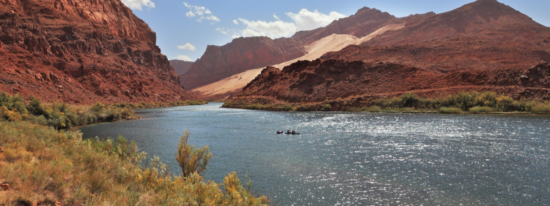
The federal government recently has acted to address the effects of the “megadrought” in the western half of the United States. These steps include (1) allocation of historic funding amounts to the U.S. Bureau of Reclamation (“Reclamation”) for the rebuilding of critical water infrastructure and water conservation programs in the West; and, within the last