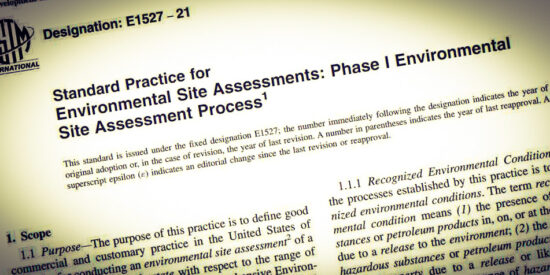
We can assist you in creating value and prospering with your selection of an environmental site assessment standard during this period of regulatory change

We can assist you in creating value and prospering with your selection of an environmental site assessment standard during this period of regulatory change
On July 14, 2022, the U.S. Department of Commerce (“Commerce”) issued a request for a range of additional factual information in connection with the agency’s ongoing circumvention inquiries into solar cells and modules from Cambodia, Malaysia, Thailand, and Vietnam that employ inputs from mainland China.[1] The deadline to respond is July 21st.

The Massachusetts Supreme Judicial Court has ruled that the Department of Environmental Protection (DEP) did not have authority to give the Secretary of Environmental Affairs the power to approve municipal harbor plans containing less stringent standards than DEP’s own regulations. Armstrong v. Sec’y Energy & Envtl. Affairs, No. SJC-13210 (Mass. July 12, 2022).
The voluntary carbon market has really taken off in the last few years, with the adoption of the Paris Agreement in 2016 and the Glasgow Climate Pact of 2021. It has been fueled also by numerous new net-zero emission commitments by governments and corporates.
Key takeaways
There’s a lot of uncertainty around the legal nature
On June 6, 2022, the New Jersey Department of Environmental Protection (“NJDEP”) proposed its long-awaited environmental justice rule (the “Proposed Rule”). The Proposed Rule will impact permitting considerations on certain new and expanded facilities, and renewals of existing major source air permits located in New Jersey’s overburdened communities. The Proposed Rule would implement the requirements
On February 23, 2021, Plaintiffs Wisconsin Manufacturers and Commerce (WMC) and Oconomowos dry cleaner sued Wisconsin’s Department of Natural Resources (WDNR) seeking declaratory relief and an order to enjoin WDNR from attempting to regulate certain emerging contaminants, including per- and polyfluorolalkyl substances (PFAS), and from enforcing the agency’s “interim decision” policy.
As part of its “PFAS Strategic Roadmap,” EPA has stated that it intends to designate PFOA and PFOS as “hazardous substances” under the Comprehensive Environmental Responses, Compensation, and Liability Act (CERCLA). EPA took the first step in this process on January 10, 2022, when it submitted its proposed rule to the White

As the April column in this series pointed out, the Infrastructure Investment and Jobs Act of 2021 reinstituted the Superfund chemical excise tax. Somehow, more than a few of our colleagues and clients have formed the expectation that environmental practitioners are the lawyers knowledgeable on this tax. Humoring them, I try here to provide a
The European Parliament and Council are in the last stages of the legislative procedure to adopt a Regulation on Batteries and Waste Batteries (“Sustainable Batteries Regulation”), which the European Commission proposed in December 2020. Among other many requirements, the proposed Sustainable Batteries Regulation will require manufacturers to ensure that the portable batteries contained in their electronic devices are removable and replaceable. These requirements will apply to a large variety of electronic devices, including household appliances, IT, telecommunications equipment, and medical devices. They are part of a broader sustainable products package that includes other legislative proposals, such as the Commission proposal for a Regulation on Ecodesign Requirements for Sustainable Products and an upcoming legislative initiative on the right to repair, and will require manufacturers to redesign the electronic devices that they market in the European Union and European Economic Area (“EU/EEA”).
The system aims to stimulate innovation in GHG-reduction activities as part of the country’s 2030 Emissions Reduction Plan.
By JP Brisson, Michael Dreibelbis, and Alicia Robinson
On June 8, 2022, Canada launched the Greenhouse Gas (GHG) Offset Credit System (the System) to create a “market-based incentive to undertake innovative projects that reduce greenhouse gases.”[1] The System, which will be administered by Environment and Climate Change Canada (ECCC) and will apply across the country, represents a key element of Canada’s 2030 Emissions Reduction Plan to reduce GHG emissions to 40–45% below 2005 levels by 2030.