
On May 30, 2023, the comment period closed on EPA’s proposed maximum contaminant levels (“MCLs”) for six PFAS at which time EPA had received 97,793 comments. Under the proposed rule EPA would set MCLs for Perfluorooctanoic acid (PFOA), Perfluorooctane sulfonic acid (PFOS), Perfluorononanoic acid (PFNA), Hexafluoropropylene oxide dimer acid and its ammonium salt (HFPO-DA
Latest from PFAS and Emerging Contaminants - Page 11
PFAS State Survey – Standards and Guidance Values for PFAS in Groundwater, Drinking Water and Surface Water
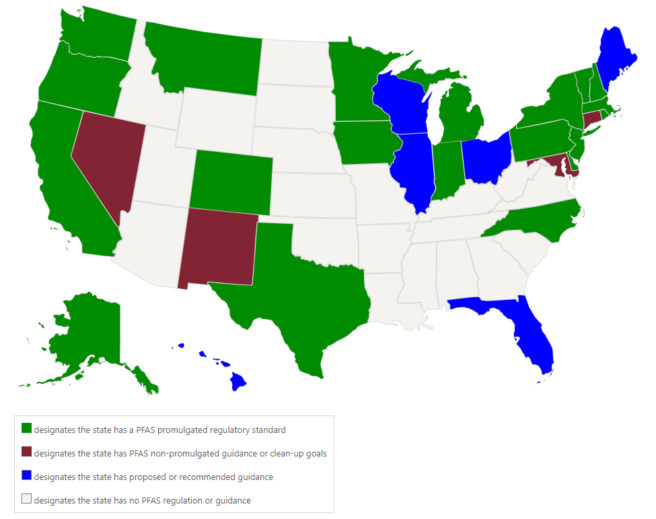
Note: This is a graphical representation of an Interstate Technology Regulatory Council (“ITRC”) Guidance Document as of March 2023.These values are changing rapidly. The ITRC intends to update this Guidance Document periodically as new information is gathered.
Source: Interstate Technology Regulatory Council (“ITRC”) PFAS Fact Sheets updated as of March 2023
EPA Requests Comments on Whether to Add More PFAS as “Hazardous Substances” under CERCLA
On April 13, 2023, the United States Environmental Protection Agency (“EPA”) published an Advanced Notice of Proposed Rulemaking (“ANPRM”) in the Federal Register that requested comments on whether EPA should consider designating certain per- and polyfluoroalkyl substances (“PFAS”) as “hazardous substances” under the Comprehensive Environmental Response, Compensation, and Liability Act (“CERCLA”) in addition to
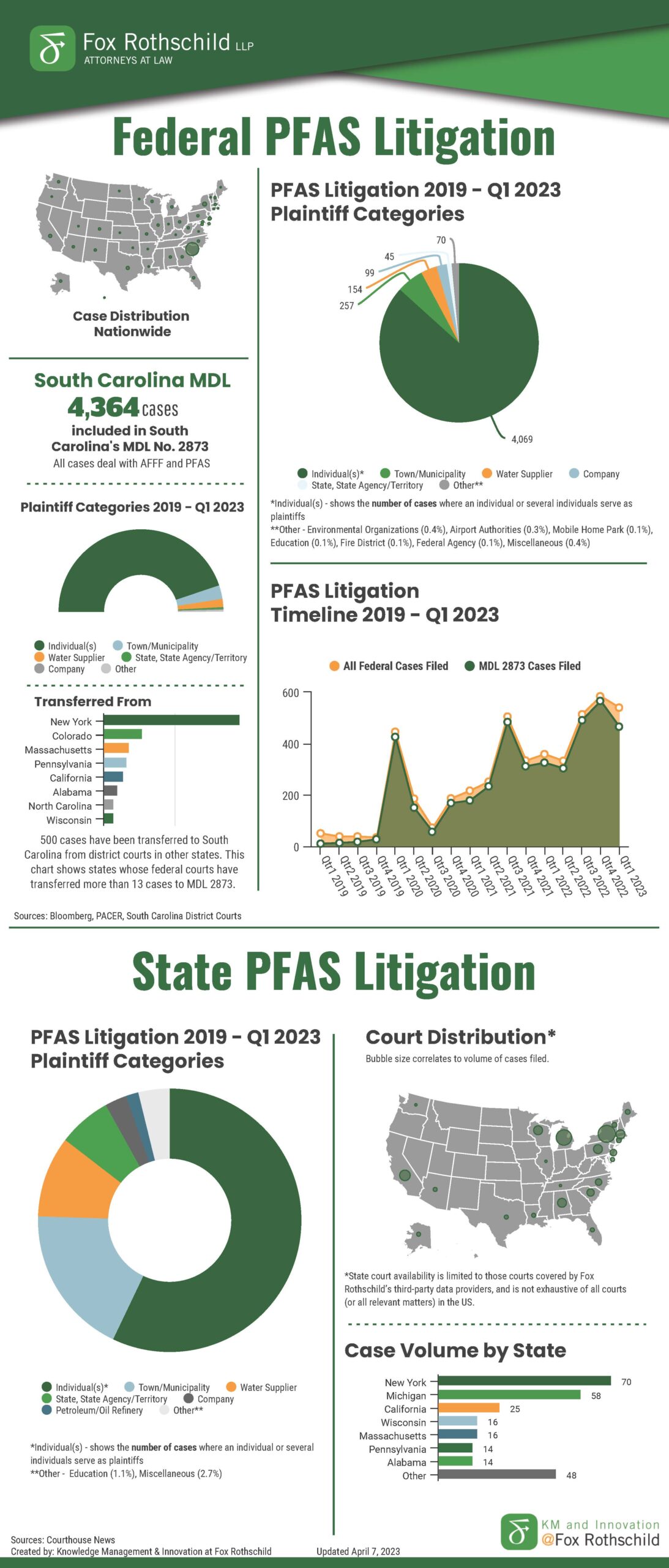
State and Federal PFAS Litigation – 2019 to Q1 2023
PFAS-related litigation continues to climb and to diversify as to claims and parties. See the attached graphics, updated through the first quarter of 2023. We will continue to update these graphics on a quarterly basis.
Delaware Resolution Requests Disposal Plan and Inventory of Aqueous Film Forming Foam Across the State
Last month, the Delaware House of Representatives and Senate passed Concurrent Resolution No. 20 (the “Resolution”) related to aqueous film forming foam (AFFF). While concurrent resolutions lack the force and effect of law, they may form joint task forces or express requests from the legislature.
Used as a fire suppressant, AFFF is a known source
EPA Proposes Maximum Contaminant Levels for Six PFAS Compounds
On March 14, 2023, the United States Environmental Protection Agency (EPA) announced the proposed National Primary Drinking Water Regulation (NPDWR) for six PFAS. The public comment period will be open for sixty (60) days following publication in the Federal Register. EPA anticipates finalizing the regulation by the end of 2023.
If finalized, the NPDWR will
Court of Appeals Dismisses Challenge to EPA’s Interim HALs for PFOA and PFOS
On January 23, 2023, a three-judge panel of the U.S. Court of Appeals for the District of Columbia Circuit granted EPA’s motion to dismiss a petition filed by the American Chemistry Council (“ACC”) challenging EPA’s interim Lifetime Health Advisory Levels (“HALs”) for perfluorooctanoic acid PFOA (0.004 ppt) and perfluorooctane sulfonic acid PFOS (0.02 ppt).
The
EPA Announces $75 Million to Pennsylvania to Address PFAS/Emerging Contaminants and Proposed PFOA and PFOS Drinking Water Standards Expected in Weeks
On February 14, 2023, the U.S. Environmental Protection Agency (“EPA”) announced $75 million in funding under the Infrastructure Law to go to Pennsylvania to address PFAS and other emerging contaminants in drinking water. The funding is part of EPA’s Emerging Contaminants in Small or Disadvantaged Communities (“EC-SDC”) Grant Program which is intended to prioritize infrastructure
New Hampshire to Receive $2.1 Million to Address PFAS and Other Emerging Contaminants
On February 24, 2023, the U.S. Environmental Protection Agency (EPA) announced that it was providing $23,186,000 to New Hampshire for clean water infrastructure upgrades. Approximately half of the funding will be in the form of grants or principal forgiveness loans. Pursuant to President Biden’s Bipartisan Infrastructure Law, the EPA will distribute the funds to New
Comment Period Deadline Approaches for EPA’s Proposed Rule Subjecting Companies to Enhanced PFAS Reporting and Notification Requirements
As a reminder, the Environmental Protection Agency (EPA) proposed a rule last month that would enhance (1) reporting of perfluoroalkyl and polyfluoroalkyl substances (PFAS) to the Toxics Release Inventory (TRI) and (2) related supplier notification requirements. The deadline to comment on EPA’s proposed rule is February 3, 2023.
The EPA’s 2021 PFAS Strategic Roadmap detailed