
As previously reported, the U.S. Environmental Protection Agency (EPA) published its most recent list of unregulated constituents to be monitored by public water systems (PWSs)—the fifth Unregulated Contaminant Monitoring Rule (“UCMR 5”)—on December 27, 2021. Requiring sampling for 30 chemical constituents between 2023 and 2025, UCMR 5 included 29 per- and polyfluoroalkyl substances (PFAS)
Latest from PFAS and Emerging Contaminants - Page 10
PFAS Among EPA’s Enforcement Initiatives
On August 17, 2023, EPA’s Office of Enforcement and Compliance Assurance (OECA) released its National Enforcement and Compliance Initiatives (NECI) for FY 2024-2027, which include addressing exposure to PFAS as an enforcement priority. To select the enforcement initiatives, EPA solicited public comment and received 88 comments from state environmental agencies, environmental groups, industry associations, and
Briefing Complete in Chemours’s Challenge to EPA’s GenX Health Advisory Level
As previously reported, The Chemours Company FC, LLC (“Chemours”) challenged the United States Environmental Protection Agency (“EPA”)’s Health Advisory Level (“HAL”) of 10 ppt for HFPO Dimer Acid, a.k.a. GenX, in the U.S. Court of Appeals for the Third Circuit. The briefing continued throughout June and July, with final briefs submitted last week.
EPA
EPA Revises Schedule for Anticipated CERCLA PFOA and PFOS Hazardous Substance Designation
In September 2022, the United States Environmental Protection Agency (“EPA”) proposed to designate perfluorooctanoic acid (“PFOA”) and perfluorooctanesulfonic acid (“PFOS”), including their salts and structural isomers, as hazardous substances under the Comprehensive Environmental Response, Compensation, and Liability Act (“CERCLA”), also known as “Superfund.” EPA received over sixty-thousand comments on its proposal during the 60-day
USGS Studies PFAS in Tap Water
As part of the PFAS Strategic Science Vision for the U.S. Geological Survey (“USGS”) and consistent with the National Defense Authorization Act for Fiscal Year 2020, which identified activities related to PFAS where USGS could provide support, the USGS undertook a study of PFAS in tap water from private and public supply wells across the
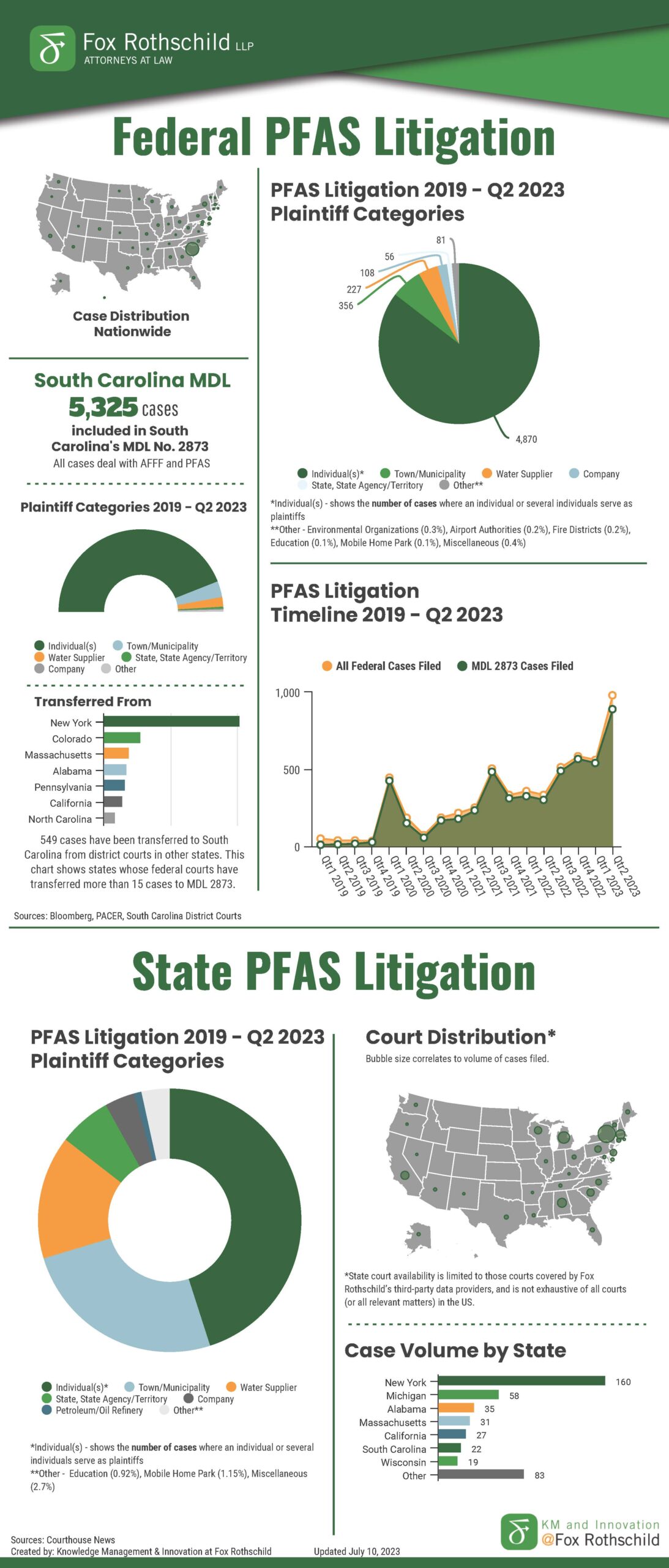
State and Federal PFAS Litigation – 2019 to Q2 2023
PFAS-related litigation continues to climb and to diversify as to claims and parties. See the attached graphics, updated through the second quarter of 2023. We will continue to update these graphics on a quarterly basis.
EPA Receives Thousands of Comments On its Proposed PFAS Maximum Contaminant Levels
As discussed in a previous post, the United States Environmental Protection Agency (EPA) proposed a National Primary Drinking Water Regulation to establish maximum contaminant levels for six different PFAS compounds: perfluorooctanoic acid (PFOA), perfluorooctane sulfonic acid (PFOS), perfluorohexane sulfonic acid (PFHxS), hexafluoropropylene oxide dimer acid (HFPO–DA) and its ammonium salt (also known as GenX
EPA Proposes to Disqualify PFAS from Low Volume Exemptions and Low Release and Exposure Exemptions under TSCA
The Toxic Substances Control Act (TSCA) authorizes the United States Environmental Protection Agency (EPA) to impose restrictions relating to chemical substances and/or mixtures as well as requirements for reporting, record-keeping, and testing. One way that the EPA regulates chemical substances and mixtures is through premanufacture notices (PMN). Like its name indicates, a PMN is submitted
Maine Presses Pause on PFAS Reporting Requirements
We reported previously on Maine’s 2021 law barring the sale of new products containing intentionally added PFAS and the reporting requirements that the law imposed upon manufacturers. Under the law, both the first phase of the sales ban and the reporting requirements were scheduled to take effect on January 1, 2023. However, pursuant to a
Briefing Continues in Chemours’s Challenge to EPA’s GenX Health Advisory Level
As previously reported, The Chemours Company FC, LLC (“Chemours”) filed a Petition for Review with the Third Circuit U.S. Court of Appeals challenging the United States Environmental Protection Agency (“EPA”)’s Health Advisory Level (“HAL”) of 10 ppt for HFPO Dimer Acid, a.k.a. GenX. A three-judge panel of the Third Circuit denied EPA’s motion to