
Soon after the Biden Administration took office, the United States Environmental Protection Agency (“EPA”) issued a Strategic Roadmap highlighting the many ways it planned to “research, restrict, and remediate” per-and poly-fluoroalkyl substances (“PFAS”) during the Administration’s first term. Among the most significant objectives of the “restrict” and “remediate” portions of the Roadmap were plans to
Latest from PFAS and Emerging Contaminants - Page 9
DuPont Companies to Pay Delaware an Extra $25 Million Under 2021 PFAS Settlement
A recent DuPont settlement in Ohio triggers additional payments to Delaware under a 2021 agreement. In June 2021, (i) E. I. du Pont de Nemours and Company, (ii) Corteva, Inc., (iii) The Chemours Company, and (iv) DuPont de Nemours, Inc. (collectively, “DuPont”) entered into a broad settlement agreement resolving Natural Resource Damage claims with the
Hardwick Ohio PFAS Class Action Dismissed for Lack of Jurisdiction
The Sixth Circuit ruled that a complaint on which a trial court had certified a class that included every person subject to the laws of Ohio must be dismissed. The complaint was filed by Kevin Hardwick, a firefighter, against ten companies that allegedly manufactured or otherwise distributed PFAS. He originally sought to represent a class
NJDEP Issues Guidance for Green, Sustainable, and Resilient Remediation
In September, NJDEP’s Contaminated Site Remediation and Redevelopment program (CSRR) issued new guidance (the Administrative Guidance for Green, Sustainable, and Resilient Remediation) encouraging the use of green and sustainable remediation (GSR) and a focus on resiliency during the remediation of contaminated sites under state statutes and rules.
As defined in NJDEP’s guidance document, GSR
EPA Finalizes Rule Removing De Minimis Exemptions, Subjecting Companies to Enhanced PFAS Reporting and Notification Requirements
We reported earlier this year that the Environmental Protection Agency’s (EPA) proposed rule would require stricter (1) reporting of perfluoroalkyl and polyfluoroalkyl substances (PFAS) to the Toxics Release Inventory (TRI) and (2) supplier notification requirements. After receiving 36 comments, the EPA made no substantive changes to the proposed rule. We distill the final rule into
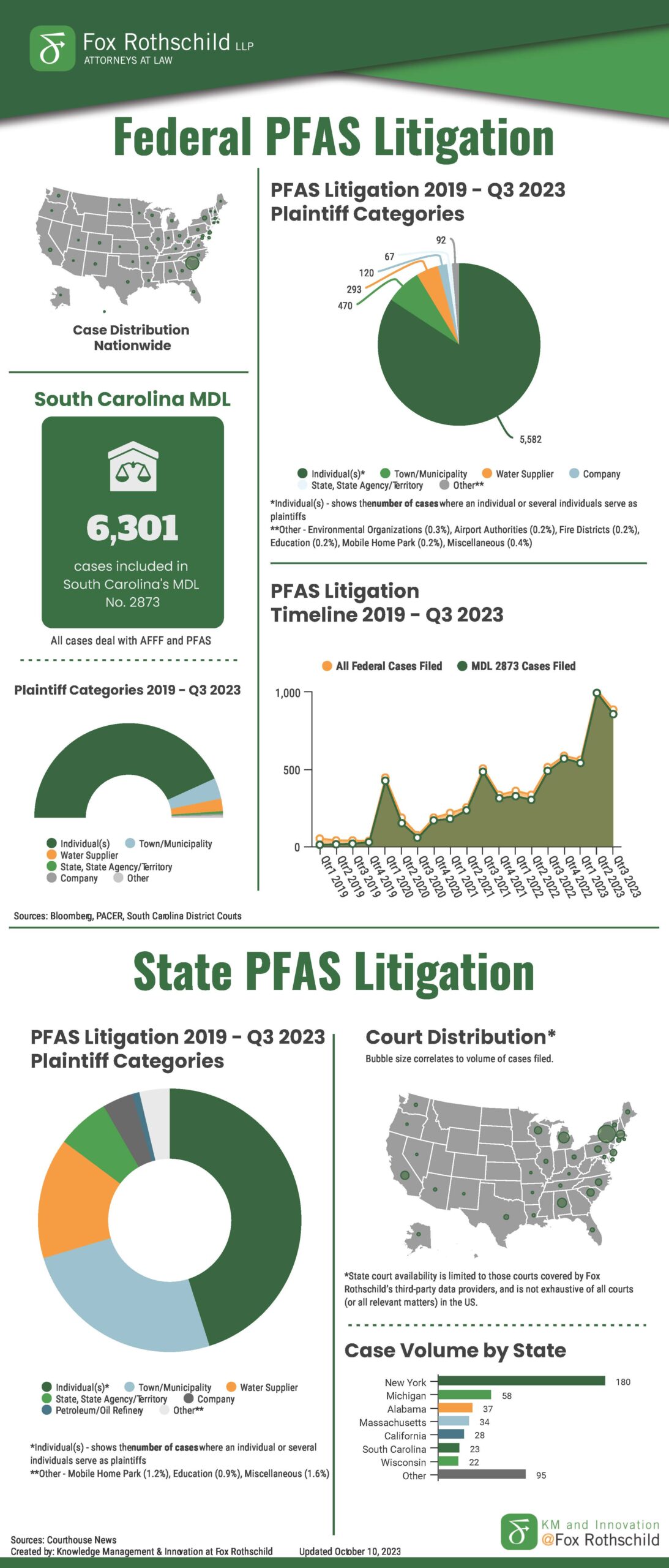
State and Federal PFAS Litigation – 2019 to Q3 2023
PFAS-related litigation continues to climb and to diversify as to claims and parties. See the attached graphics, updated through the third quarter of 2023. We will continue to update these graphics on a quarterly basis.
PFAS Class Action Against Cosmetic Company Dismissed
In March 2022, a putative class action lawsuit was filed in the U.S. District Court for the Southern District of New York against L’Oreal U.S.A., Inc. alleging that the company had violated a host of state consumer protection laws by failing to disclose that several of its waterproof mascara products contain PFAS. On September 30,
Consumer Product Safety Commission Seeks Insights About PFAS in Consumer Products
The Consumer Product Safety Commission (CPSC) recently released a Request for Information (RFI) to gather information from all stakeholders to better understand the potential presence and uses of per- and polyfluoroalkyl substances (PFAS) in consumer products. The RFI is designed to gather information and comment on a voluntary basis to inform the CPSC and the
Update on U.S. EPA’s Proposed Rule to Designate PFOA and PFOS as Hazardous Substances Under CERCLA
We have been closely monitoring the progress of the United States Environmental Protection Agency (“EPA”) proposed rule to designate perfluorooctanic acid (“PFOA”) and perfluorooctane sulfonic acid (“PFOS”), two per- and poly-fluoroalkyl substances (“PFAS”), as hazardous substances under the federal Comprehensive Environmental Response, Compensation, and Liability Act (“CERCLA”). If finalized, the rule would have far-reaching consequences
Minnesota Statute Takes a Robust Approach to PFAS Regulation, Including Reporting Requirements for Manufacturers and a Sales Ban
On May 24, 2023, Minnesota’s Governor signed into law a sweeping set of statutory provisions concerning the handling and sale of PFAS-containing products within Minnesota. Among other things, the statute sets a ban on various categories of products containing PFAS, imposes reporting requirements for manufacturers, and directs the Minnesota Pollution Control Agency (“MPCA”) to adopt