
On June 7, the U.S. Fish and Wildlife Service (FWS) issued a proposed rule titled, “Endangered and Threatened Wildlife and Plants; Designation of Experimental Populations.” In issuing the proposed rule, FWS re-affirms its authority to designate and introduce experimental populations of protected species into areas of habitat outside of their historical range when climate change, invasive species, or other threats have affected or will affect that range. Importantly, this proposal only applies to species managed by FWS. Species managed by NMFS are governed by separate regulations, which NMFS updated back in 2016. These changes will make the FWS regulations more similar to those of NMFS. Pursuant to NMFS’ existing regulations, experimental populations of salmon have been re-introduced in certain waterways in the Western United States. FWS’s proposal could result in similar re-introduction of experimental populations of terrestrial and freshwater species.
Biden Administration Releases “Phase 1” of NEPA Revisions
On April 20, the Council on Environmental Quality (CEQ) issued a Final Rule, revising certain sections of its regulations implementing the National Environmental Policy Act (NEPA). The Final Rule represents “Phase 1” of the Biden administration’s plan to reverse the Trump-era rulemaking, which significantly revised the NEPA regulations for the first time since 1978.
NEPA, sometimes referred to as a “paper tiger,” requires federal agencies to take a “hard look” at the environmental impacts of certain proposed projects but does not mandate any particular outcome. In July 2020, the Trump administration issued its Final Rule, which represented the first update to the NEPA regulations in over 40 years. The 2020 rule contained numerous revisions, many of which were intended to speed up infrastructure projects by reducing delays and paperwork during NEPA reviews. It also revised the definition of “effects,” which traditionally included “direct, indirect, and cumulative effects,” by reducing it to one short paragraph and eliminating references to these three categories, and instead providing that “effects” should not be analyzed “if they are remote in time, geographically remote, or the product of a lengthy causal change.”
New Bureau of Land Management Guidance on Geologic Carbon Sequestration on Federal Public Lands Answers Some Questions, But Uncertainty Remains for Split-Estate Lands
On June 8, 2022, the U.S. Department of the Interior’s Bureau of Land Management (BLM) issued formal guidance[1] describing BLM’s policy for authorizing use of federal public lands for site characterization, injection, and geologic sequestration of carbon dioxide (CO2) for carbon capture and storage (CCS). BLM Instruction Memorandum 2022-041 (IM
The European Union Adopted New Rules for the Trans-European Networks for Energy
On 30 May 2022, the European Union (“EU”) adopted the revised Regulation on guidelines for trans-European energy infrastructure (No. 2022/869) (the “TEN-E Regulation 2022”), which replaces the previous rules laid down in Regulation No. 347/2013 (the “TEN-E Regulation 2013”) that aimed to improve security of supply, market integration, competition and sustainability in the energy sector. The TEN-E Regulation 2022 seeks to better support the modernisation of Europe’s cross-border energy infrastructures and the EU Green Deal objectives.
The three most important things you need to know about the TEN-E Regulation 2022:
- Projects may qualify as Projects of Common Interest (“PCI”) and be selected on an EU list if (i) they fall within the identified priority corridors and (ii) help achieve EU’s overall energy and climate policy objectives in terms of security of supply and decarbonisation. The TEN-E Regulation 2022 updates its priority corridors to address the EU Green Deal objectives, while extending their scope to include projects connecting the EU with third countries, namely Projects of Mutual Interest (“PMI”).
- PCIs and PMIs on the EU list must be given priority status to ensure rapid administrative and judicial treatment.
- PCIs and PMIs will be eligible for EU financial assistance. Member States will also be able to grant financial support subject to State aid rules.
New Jersey Supreme Court reaffirms public policy underpinning the NJ rescue doctrine is limited to the protection of human life
Injuries to a woman who heroically jumped in a canal to save a neighbor’s dog were not considered viable as a cause of action under the state’s rescue doctrine. See Ann Samolyk v. Dorothy Berthe, III, No. A-16-21 (085946) (N.J. June 13, 2022). The State’s highest court declined to extend the rescue doctrine
TCEQ Approves Changes to Compliance History Rules Focused on Industrial Incidents

Prompted by several emergency events, as previously reported, on June 1, 2022, the Texas Commission on Environmental Quality (TCEQ) adopted revisions to the compliance history rules to authorize the executive director to reclassify a site’s compliance history if an “exigent circumstance” exists. An exigent circumstance is defined as: i) a significant disruption to one or more local communities; ii) a significant commitment of emergency response resources by a federal or state authority to address an actual unauthorized release of pollutants, contamination, or other materials regulated by the agency; and iii) a significant event the commission determined must be urgently accounted for in the site’s compliance history.
NJ Bill Could Impose Unwarranted Animal Forfeiture
By Meghan Currie, a summer associate at Fox Rothschild LLP, based in the firm’s Princeton office
A recent Bill, A2354, introduced in February of this year by New Jersey legislators should be on the forefront of any New Jersey animal owner’s mind. The Bill proposes amendments, bolstering existing animal cruelty statute 4:22-17, which addresses
Shale Law Weekly Review—Week of June 13, 2022
Hydraulic Fracturing: Ninth Circuit Grants Summary Judgment Against Federal Agencies in Offshore Drilling Case
On June 3, 2022, the U.S. Court of Appeals for the Ninth Circuit affirmed a grant of summary judgment to environmental groups, the State of California, and the California Coastal Commission (together, “plaintiffs”) in their lawsuit against federal agencies including the
GT’s Environmental Practice Recognized in The Legal 500 United States 2022 Guide
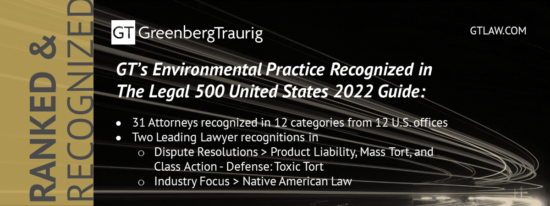
Thirty-one attorneys in 12 U.S. offices from the Environmental Practice of global law firm Greenberg Traurig, LLP are recognized in The Legal 500 United States 2022 Guide. David B. Weinstein was recognized in the U.S. Guide as a “Leading Lawyer” for Dispute Resolution > Product Liability, Mass Tort, and Class Action – Defense: Toxic
Jury Still Out On EJ-Focused Enforcement Results, Former EPA GC Says

In a wide-ranging interview on environmental justice (EJ) issues with Inside EPA, Hunton Andrews Kurth LLP partner Matt Leopold discussed the US Department of Justice (DOJ) and Environmental Protection Agency’s (EPA) new enforcement strategy.