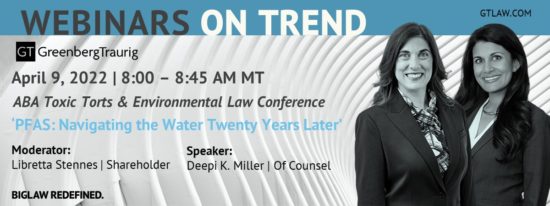
Libretta Stennes, a shareholder in global law firm Greenberg Traurig, LLP’s Minneapolis office, and Deepi K. Miller, an of counsel in the firm’s Sacramento office, will speak at the American Bar Association (ABA) 30th Annual Toxic Torts and Environmental Law Conference taking place April 7-9 in Scottsdale, Arizona.


Click here

On March 3, 2022, the U.S. Environmental Protection Agency (“EPA”) released its 2020 Toxics Release Inventory (“TRI”) National Analysis report.  EPA’s report analyzes the most recent Toxic Release Inventory (“TRI”) data and conducts comparative analysis with TRI data reported from previous years.  EPA’s analysis  is the first to feature data on the 172 per- and

On April 5 and 7, 2022, the State Water Resources Control Board (Board) will be holding public workshops to present information and solicit public input regarding a proposed administrative draft of a hexavalent chromium (chromium-6) maximum contaminant level (MCL). MCLs are drinking water standards with which public water systems must comply. The workshops, and administrative draft of the MCL, will help inform the Board’s formal rulemaking, expected to begin later this year. If adopted, the MCL would be the first drinking water standard for chromium-6 in the nation. [1]

By Benjamin D. BriggsA. Scott HeckerAdam R. Young, Mark A. Lies, and Craig B. Simonsen

Seyfarth Synopsis: The Occupational Safety and Health Administration is proposing to amend its occupational injury and illness recordkeeping regulation, 29 CFR 1904.41. The current regulation requires certain employers to electronically submit injury

Last week, the Securities and Exchange Commission (SEC) revealed its much-anticipated proposal to require that public companies disclose climate-related information. The proposed rule is significant because, for the first time, the SEC would mandate that companies (including foreign companies) publicly traded in the US disclose climate-related risk and greenhouse gas (GHG) emissions information beyond the risk information currently required by existing SEC rules applicable to registration statements and annual reports.

The Fifth Circuit recently allowed the federal government to resume use of the “social cost of carbon” (SCC), after a district court enjoined reliance on the metric earlier this year.  The SCC aids cost-benefit analysis of regulatory actions and can provide insights into the impacts of climate change and greenhouse gas emissions reductions.  The continued

The sustainable investing market has witnessed remarkable growth. At the same time, the field has been challenged by a lack of consistency in identifying what, exactly, makes an investment “sustainable”.  Sustainability taxonomies (or classification systems) have been developed by governments, international bodies and non-governmental organizations to help identify specific assets, activities or projects that meet defined thresholds and metrics that quantify sustainability.  Many of these taxonomies refer to or emulate the EU Taxonomy, widely regarded as the most developed system for sustainable finance investment classification and measurement.

The Securities and Exchange Commission (SEC or Commission) published proposed rules on March 21 that, for the first time, would codify the Commission’s expectations regarding what kinds of climate-related disclosures public companies must make in their required filings to the SEC. Prior to now, companies have had to rely on 2010 guidance from the Commission to determine what information they should disclose to investors regarding their climate-related risks.